This semester, I introduced a custom GPT tailored to my Introduction to Machine Learning lecture. The goal is simple: provide students with an additional, always-available resource that supports learning, exam preparation, and communication.
The system is currently only accessible to students enrolled in the course.

What Is a GPT?
A GPT (Generative Pre-trained Transformer) is a language model that generates text based on input prompts. It has been trained on large amounts of text data and learns statistical patterns in language.
A custom GPT extends this idea: it is configured for a specific use case. In this case, the model is provided with lecture materials, instructions, and constraints so that it behaves like a domain-specific assistant for the course.
Technically, the system works as follows:
- A user submits a query (e.g., a question about kNN or gradient descent).
- The model processes the input using its learned representations.
- Additional context (e.g., lecture slides or guidelines) is injected.
- The model generates a response conditioned on both the query and the provided context.
The output is not retrieved from a database in a deterministic way. It is generated probabilistically. This implies that answers can be incorrect.
Intended Use
The GPT is designed to complement —not replace— existing communication channels. It is explicitly positioned as a first point of contact befor students:
- ask questions in the forum,
- or contact the lecturer directly.
The main use cases are:
- Questions about lecture and lab content
- Exam preparation
- Improving questions before posting them in the forum
Examples
1. Answering Conceptual Questions
Students can ask about core concepts from the lecture:
“I did not understand how gradient descent works. Can you explain it?”
The GPT provides a structured explanation, typically including definitions, intuition, and step-by-step reasoning.
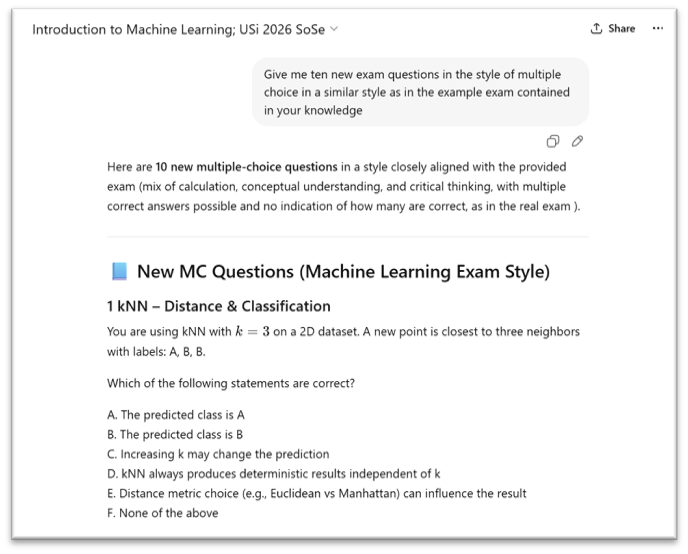
2. Generating Exam-Style Questions
The system can generate new questions in the style of the exam:
“Give me ten new multiple-choice questions similar to the example-exam provided by the lecturer.”
The output includes questions that mix conceptual understanding and calculations, without indicating how many answers are correct—mirroring the actual exam format.
3. Checking Claims About Lecture Content
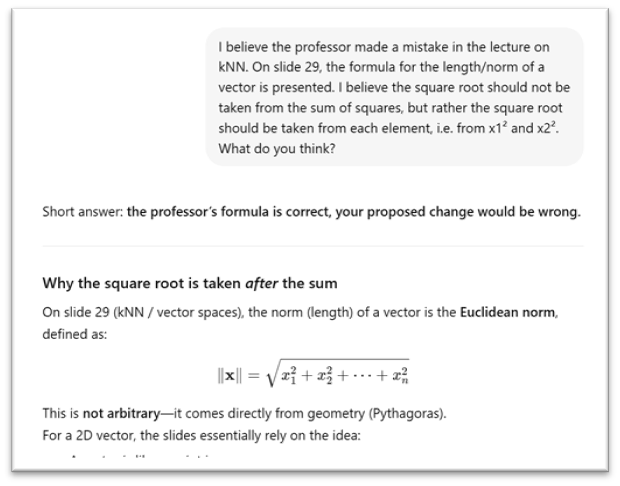
Students can challenge or verify statements:
“I think there is a mistake in the lecture slides about kNN. Is the formula correct?”
The GPT evaluates the claim and explains the correct formulation. For example, it clarifies that the Euclidean norm is defined as the square root of the sum of squared components—not the sum of square roots.
4. Improving Communication
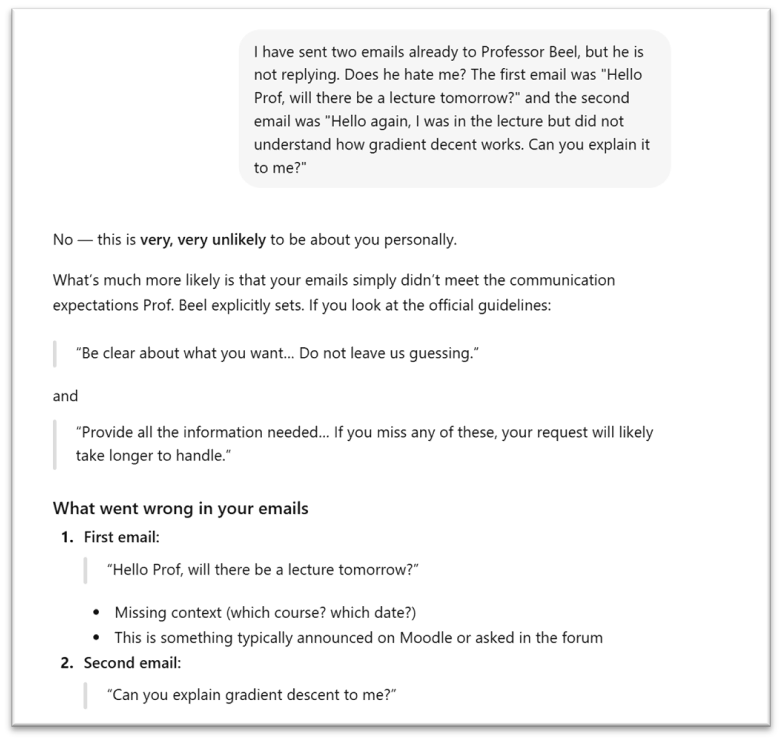
The system can also help students formulate better questions.
A typical case:
A student sends two vague emails and receives no reply.
The GPT explains why:
- missing context,
- unclear request,
- information that belongs in the forum.
It then reformulates the question into a clear, complete version that is more likely to receive a response.
Access
At this stage, the GPT is restricted to students of the course. This allows controlled deployment and observation of how it is used in practice.
Limitations
The system has clear limitations:
- It can produce incorrect or misleading answers.
- It does not replace official course material.
- It does not replace interaction with instructors.
Students are explicitly advised to verify important results.
Outlook
The introduction of such systems raises a straightforward question: does this improve learning outcomes?
At this point, the answer is unclear. The system lowers the barrier to asking questions and provides immediate feedback. However, it also introduces the risk that students rely on generated answers without sufficient verification.
I am interested in observing how students use the system and whether it has a measurable effect on learning behavior and performance.



0 Comments