AI is starting to take over substantial parts of science. The idea of an AI Scientist is decades old, and AI contributed to scientific breakthroughs long before 2026. But something changed this year. AI agents are beginning to run meaningful parts of the research process themselves. At the same time, Google, OpenAI, Anthropic, Meta, Microsoft and others are putting serious resources into automating research. And, most importantly, we now have results.
My hypothesis is that we are seeing a natural progression through four generations of AI applications.
1st Generation: Chat. AI learned to understand language and communicate with us.
2nd Generation: Code. AI learned to generate software and, with it, create and use tools. Code gives an AI a way to act: process data, call APIs, operate computers, run programs, observe the result and try again.
3rd Generation: Research. AI Scientists combine language, code and tool use in a research loop: understand existing knowledge, formulate hypotheses, build the tools needed to test them, run experiments, evaluate the evidence and decide what to try next. I use AutoResearch for this broader idea. In current systems, however, humans still define the research direction. We decide which problem to work on, what the objective is and how much time, compute and money to allocate.
4th Generation: Autonomous Science. The next step is an AI Scientist that can also decide what to research. It could identify open questions, generate new ideas, estimate which ones are worth pursuing, prioritize them, allocate resources and run research programs over long periods with little or no human intervention. At that point, the technical question is no longer only what the AI can do. It is also where humans want to remain in control: choosing the goals, setting the budget, approving experiments, or perhaps only defining broad boundaries.
The progression seems natural. First build a system that understands and communicates. Then let it create code and use tools. Then put those capabilities into a research loop. Finally, let the system choose and prioritize the research itself. If the subject of that research is AI, such a system could propose better algorithms, implement them, run experiments, evaluate the results and decide what to try next. That would put many of the ingredients for recursive self-improvement into one autonomous loop. Whether this leads to superintelligence remains an open question, but the path from today’s AI Scientists to such a system is becoming easier to describe.
So, what actually happened in 2026?
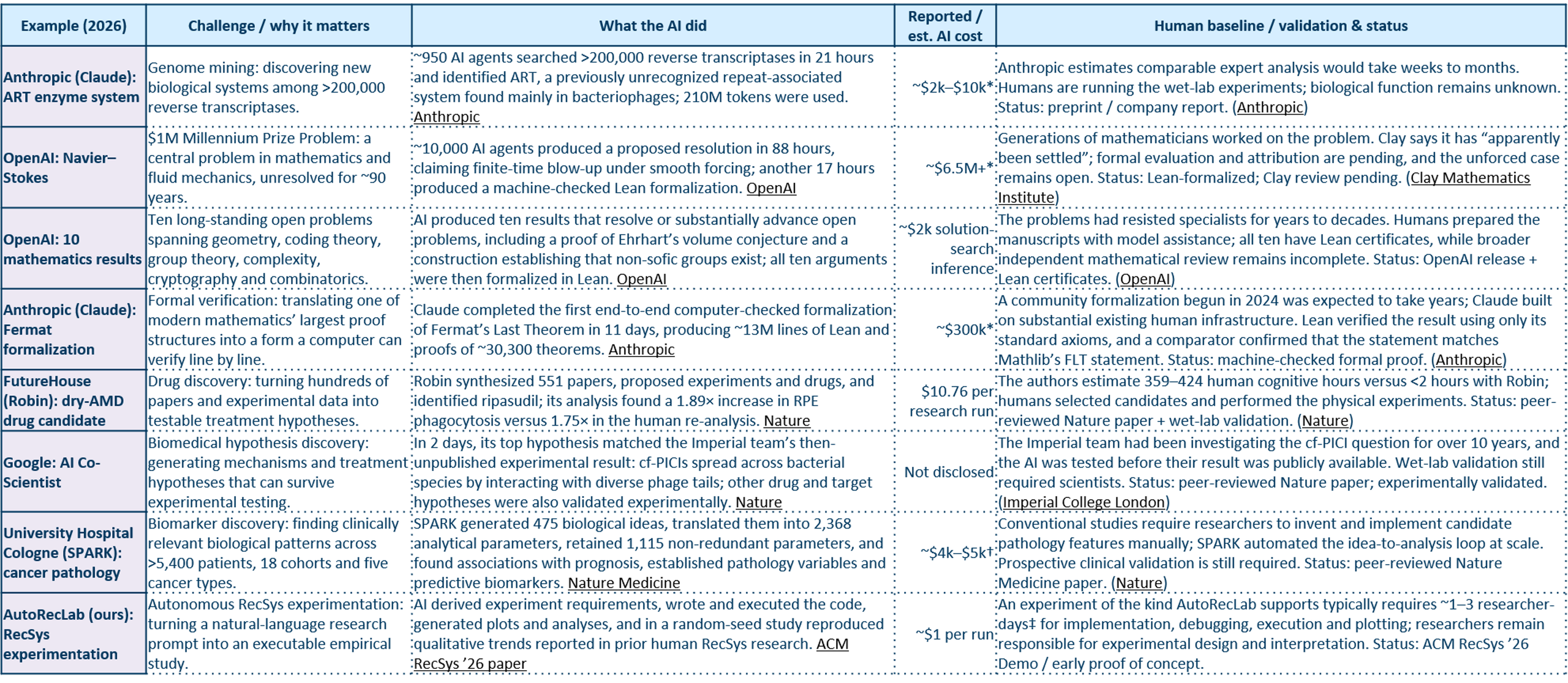
The table below contains eight examples published or reported in 2026. Some underlying systems existed earlier. I selected examples where the AI did more than summarize literature or answer questions. It generated hypotheses, searched large spaces, wrote and executed code, analysed experimental evidence, constructed mathematical arguments or reproduced earlier research results.
There are four numbers I would look for in every row: what came out, how long it took, how much work could be done in parallel and what the AI cost.
| Example (2026) | Challenge / why it matters | What the AI did | Reported / est. AI cost | Human baseline / validation & status |
|---|---|---|---|---|
| Anthropic (Claude): ART enzyme system | Genome mining: discovering new biological systems among >200,000 reverse transcriptases. | ~950 AI agents searched >200,000 reverse transcriptases in 21 hours and identified ART, a previously unrecognized repeat-associated system found mainly in bacteriophages; 210M tokens were used. Anthropic | ~$2k–$10k* | Anthropic estimates comparable expert analysis would take weeks to months. Humans are running the wet-lab experiments; biological function remains unknown. Status: preprint / company report. Anthropic |
| OpenAI: Navier–Stokes | $1M Millennium Prize Problem: a central problem in mathematics and fluid mechanics, unresolved for ~90 years. | ~10,000 AI agents produced a proposed resolution in 88 hours, claiming finite-time blow-up under smooth forcing; another 17 hours produced a machine-checked Lean formalization. OpenAI | ~$6.5M+* | Generations of mathematicians worked on the problem. Clay says it has “apparently been settled”; formal evaluation and attribution are pending, and the unforced case remains open. Status: Lean-formalized; Clay review pending. Clay Mathematics Institute |
| OpenAI: 10 mathematics results | Ten long-standing open problems spanning geometry, coding theory, group theory, complexity, cryptography and combinatorics. | AI produced ten results that resolve or substantially advance open problems, including a proof of Ehrhart’s volume conjecture and a construction establishing that non-sofic groups exist; all ten arguments were then formalized in Lean. OpenAI | ~$2k solution-search inference | The problems had resisted specialists for years to decades. Humans prepared the manuscripts with model assistance; all ten have Lean certificates, while broader independent mathematical review remains incomplete. Status: OpenAI release + Lean certificates. OpenAI |
| Anthropic (Claude): Fermat formalization | Formal verification: translating one of modern mathematics’ largest proof structures into a form a computer can verify line by line. | Claude completed the first end-to-end computer-checked formalization of Fermat’s Last Theorem in 11 days, producing ~13M lines of Lean and proofs of ~30,300 theorems. Anthropic | ~$300k* | A community formalization begun in 2024 was expected to take years; Claude built on substantial existing human infrastructure. Lean verified the result using only its standard axioms, and a comparator confirmed that the statement matches Mathlib’s FLT statement. Status: machine-checked formal proof. Anthropic |
| FutureHouse (Robin): dry-AMD drug candidate | Drug discovery: turning hundreds of papers and experimental data into testable treatment hypotheses. | Robin synthesized 551 papers, proposed experiments and drugs, and identified ripasudil; its analysis found a 1.89× increase in RPE phagocytosis versus 1.75× in the human re-analysis. Nature | $10.76 per research run | The authors estimate 359–424 human cognitive hours versus <2 hours with Robin; humans selected candidates and performed the physical experiments. Status: peer-reviewed Nature paper + wet-lab validation. Nature |
| Google: AI Co-Scientist | Biomedical hypothesis discovery: generating mechanisms and treatment hypotheses that can survive experimental testing. | In 2 days, its top hypothesis matched the Imperial team’s then-unpublished experimental result: cf-PICIs spread across bacterial species by interacting with diverse phage tails; other drug and target hypotheses were also validated experimentally. Nature | Not disclosed | The Imperial team had been investigating the cf-PICI question for over 10 years, and the AI was tested before their result was publicly available. Wet-lab validation still required scientists. Status: peer-reviewed Nature paper; experimentally validated. Imperial College London |
| University Hospital Cologne (SPARK): cancer pathology | Biomarker discovery: finding clinically relevant biological patterns across >5,400 patients, 18 cohorts and five cancer types. | SPARK generated 475 biological ideas, translated them into 2,368 analytical parameters, retained 1,115 non-redundant parameters, and found associations with prognosis, established pathology variables and predictive biomarkers. Nature Medicine | ~$4k–$5k† | Conventional studies require researchers to invent and implement candidate pathology features manually; SPARK automated the idea-to-analysis loop at scale. Prospective clinical validation is still required. Status: peer-reviewed Nature Medicine paper. Nature Medicine |
| AutoRecLab (ours): RecSys experimentation | Autonomous RecSys experimentation: turning a natural-language research prompt into an executable empirical study. | AI derived experiment requirements, wrote and executed the code, generated plots and analyses, and in a random-seed study reproduced qualitative trends reported in prior human RecSys research. ACM RecSys ’26 paper | ~$1 per run | An experiment of the kind AutoRecLab supports typically requires ~1–3 researcher-days‡ for implementation, debugging, execution and plotting; researchers remain responsible for experimental design and interpretation. Status: ACM RecSys ’26 Demo / early proof of concept. |
* Estimated AI cost based on reported model usage; actual internal costs may differ. † SPARK reports total development/implementation cost, not pure inference cost. ‡ AutoRecLab human effort is a rough estimate, not measured in the paper. General note: AI costs exclude model training, researcher salaries, laboratory work, equipment and later validation.
Effective: these systems are producing results that survive contact with reality
For me, this is the biggest change. We are no longer asking whether an AI can produce a paper that looks scientific. Several systems in the table produced results that could be checked independently.
Robin proposed ripasudil and calculated a 1.89× increase in RPE phagocytosis. The human re-analysis of the same experiment found 1.75×. Google’s AI Co-Scientist needed two days to produce a hypothesis matching an experimental result that the Imperial team had reached after more than ten years of work and had not yet published. SPARK generated 475 biological ideas, turned them into 2,368 analytical parameters and tested the resulting features across more than 5,400 patients in 18 cohorts.
Mathematics provides an even harder form of validation. OpenAI’s ten mathematics results were all formalized in Lean. Claude’s Fermat project produced around 13 million lines of Lean and proofs of roughly 30,300 theorems. A computer can check those proofs line by line. The Navier–Stokes result is more appropriately described as a proposed resolution: the formalization exists and Clay says the problem has “apparently been settled,” but independent review and the formal Clay process are still ongoing.
The level of validation is therefore different across the rows, as it should be. Wet-lab biology still needs a wet lab. Clinical claims still need patients and prospective validation. Mathematics can increasingly use proof assistants. Software can be compiled and executed. This distinction will matter enormously: AutoResearch should progress fastest where AI can obtain reliable feedback without waiting for a human.
Fast: years of research can become days
The time compression is extraordinary. Robin’s authors estimate 359–424 hours of human cognitive work for the corresponding literature and reasoning workflow. That is roughly 9–11 full-time working weeks. Robin completed its computational part in less than two hours.
The Imperial team had investigated the cf-PICI question for more than ten years. Google’s AI Co-Scientist generated its matching top hypothesis in two days. Anthropic estimates that experts would need weeks to months for the genome-mining work behind ART; around 950 Claude agents searched more than 200,000 reverse transcriptases in 21 hours.
The Fermat formalization is another useful comparison. A community project started in 2024 and was expected to take years. Claude completed an end-to-end machine-checked formalization in 11 days, admittedly while building on substantial mathematical and software infrastructure created by humans.
Then there is Navier–Stokes. Mathematicians have worked on the underlying problem for roughly 90 years. OpenAI threw around 10,000 agents at it and produced a proposed forced-case resolution in 88 hours, followed by a Lean formalization in another 17 hours. Whether the result ultimately receives full acceptance is a separate question. The ability to concentrate that much intellectual search into a few days is already remarkable.
Scalable: science becomes less constrained by the number of available scientists
This may be the property that changes science the most.
Human research does not parallelize easily. If a difficult mathematical problem has only a few dozen people in the world with the necessary expertise, we cannot decide tomorrow to put 10,000 equally qualified mathematicians on it. Training another generation takes years. The same applies to specialized programmers, computational biologists or machine-learning researchers.
AI changes that constraint. Anthropic can launch roughly 950 agents and search more than 200,000 biological candidates in 21 hours. OpenAI can put roughly 10,000 agents on a single mathematical problem. SPARK can start with 475 biological ideas and automatically turn them into thousands of measurable features. The limiting resource for the computational part of the research increasingly becomes compute rather than the number of experts who happen to be available.
Even if an AI researcher were only as effective as a human researcher per unit of work, this ability to parallelize would already be transformative. Ten thousand competent researchers working on one problem for several days would be an extraordinary scientific mobilization. With AI agents, it becomes an engineering and compute-budget decision.
This changes the value of time. An important research problem may remain unsolved for decades simply because there are too few people able or willing to pursue every plausible direction. AutoResearch can search many directions simultaneously. Some will fail. That is fine. The point of scale is that failure in one branch does not stop the other thousand branches.
Physical experiments remain harder to scale. You cannot duplicate a patient cohort or a wet lab as cheaply as an AI agent. But much of the work before an expensive experiment — reading, proposing mechanisms, writing code, simulation, screening candidates and analysing results — can increasingly be parallelized.
Cheap: another research attempt can cost dollars rather than researcher-days
The costs in the table span almost seven orders of magnitude, from about $1 to more than $6.5 million. Among the seven examples for which a cost is reported or estimated, five are around $10,000 or less.
Robin costs $10.76 per research run. OpenAI reports roughly $2,000 of solution-search inference for ten mathematical results. ART is estimated at a few thousand dollars. SPARK is in roughly the same range. These are tiny numbers compared with the cost of months of expert research time.
Fermat, at roughly $300,000 by our estimate, is already a different category. Navier–Stokes, at more than $6.5 million, is genuinely expensive. But I am not sure that “expensive” is the right comparison.
If a problem is important enough that generations of researchers have spent decades on it, a few million dollars may be cheap. The relevant cost is not only the compute bill. It is also the value of receiving an answer years earlier. In mathematics that means years of follow-up work can start earlier. In engineering it can mean an earlier technology. In medicine it can mean an earlier treatment candidate. The cost of waiting can be much larger than the cost of compute.
This is why scalability and cost belong together. Once more research effort can be purchased with compute, organizations can make an explicit decision: this problem is important enough that we will put 100, 1,000 or 10,000 agents on it. We cannot buy 10,000 additional expert scientists overnight. We can buy more inference.
The major AI companies are now building AutoResearch
The individual results are only half of what makes 2026 interesting. AutoResearch is now becoming a major direction across the AI industry.
Google has Scientist-One, ScientistTwo, AI Co-Scientist and Gemini for Science. Anthropic has Claude Science. Microsoft has Microsoft Discovery. OpenAI is deploying large populations of agents on mathematical research. Meta has its Ranking Engineer Agent and Auto-RecSys for autonomous experimentation on industrial recommender systems.
The progression from Chat to Code to Research is even visible in some of the product lines. Claude became Claude Code and then Claude Science. The underlying models keep gaining better access to tools, execution environments, data and long-running feedback loops. Research is a natural next application once language understanding, code generation and tool use work well enough together.
This is why I see 2026 as more than another year with a few interesting AI-for-science papers. AutoResearch is becoming an engineering discipline and a product category at companies with the models, infrastructure and compute to scale it.
And yes, AutoRecLab is in my table
There is one obvious conflict of interest in the table: AutoRecLab is our project. Of course I included it. I also naturally assume that it is on its way to becoming the greatest recommender-systems research tool of all time. 😉
The serious reason for including it is that AutoRecLab illustrates the same trend at a much smaller and more accessible scale. You do not need a $6.5 million compute budget to automate useful research work.
Our interest in this started with our evaluation of Sakana’s AI Scientist. We found a system that was fascinating but unreliable. Five of twelve experiments failed because of coding errors. That experience pushed us toward a narrower question: can we make the experimental part of recommender-systems research reliable enough to automate?
In From AutoRecSys to AutoRecLab, we described the larger vision: move beyond AutoRecSys systems that automate algorithm selection and hyperparameter optimization toward an autonomous research lab covering much more of the scientific process.
Our current AutoRecLab concentrates on experimentation. A researcher provides a natural-language research prompt. AutoRecLab derives the experiment requirements, writes and executes the code, generates plots and analyses the results. In our RecSys ’26 work, it reproduced qualitative trends from earlier human recommender-systems research.
The marginal model cost is around $1 per run. We estimate that an experiment of the kind currently supported by AutoRecLab would normally require roughly one to three researcher-days for implementation, debugging, execution and plotting. Of course, the researcher still has to ask a sensible question and judge whether the experiment answers it. But moving several days of implementation work toward a $1 marginal AI cost is exactly the kind of economic shift that could increase research throughput.
AutoRecLab is still an early proof of concept and considerably narrower than the most ambitious AI Scientists in the table. That is also why I like it. Experimental code provides immediate feedback: it runs or it fails, types can be checked, outputs can be inspected and an agent can revise its implementation. This gives us a tractable route from coding agents toward increasingly complete research agents.
Our recent survey on AI Scientists and Autonomous Research looks at this development more broadly. We currently catalogue 62 research-agent systems. The survey also reaches a conclusion that is visible throughout the table above: generating research is becoming easier to scale than validating it.
After Chat and Code comes Research
My bet is that Research will become the third major generation of AI applications.
Chat made intelligence accessible through language. Code gave AI the ability to build tools and act. Research combines both inside a feedback loop that can generate and test new knowledge.
2026 is the first year in which I see all the pieces coming together at once. The systems are effective enough to produce externally checkable results. Some compress months or years of work into hours or days. Hundreds or thousands of agents can work in parallel. And five of the seven examples with known or estimated costs in the table are around $10,000 or less.
For computational research, the scarce resource may gradually shift from expert headcount toward money and compute. That is a profound change. If a scientific question is sufficiently important, we can increasingly decide to spend more compute, launch more agents and search more possibilities now, instead of waiting years for enough human research time to accumulate.
And once AI Scientists start researching AI itself, the loop becomes even more interesting. An AI can help design the next algorithm, implement it, run the experiments, analyse the result and use the evidence to decide what to try next. We should be careful about jumping from that observation to claims about superintelligence. But recursive improvement no longer requires imagining an entirely new kind of system. Many of the required components are already visible.
That is why I find 2026 so exciting. AI Scientists are becoming effective, fast, scalable and cheap. If this continues, the speed of science itself may become one of the most important things AI changes.

0 Comments