We announce LensKit-Auto 0.1.1, our open-source AutoRecSys library built on the Python LensKit recommender system framework.
What is LensKit-Auto?
Originally introduced as a Demo paper at the 17th ACM Conference on Recommender Systems (RecSys 2023), LensKit-Auto simplifies the labor-intensive parts of recommender systems research by automating the entire recommender systems pipeline. It tackles the combined algorithm selection and hyperparameter optimization (CASH) problem and can build ensemble models using LensKit algorithms. With LensKit-Auto, developers can identify the best-performing model for their dataset with just one function call, e.g., get_best_recommender_model().
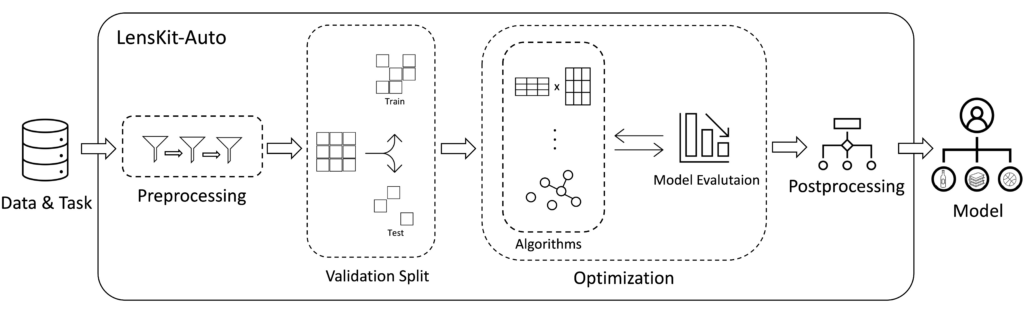
Navigating the 2025 LensKit Restructuring
In 2025, the core LensKit framework underwent a massive restructuring, fundamentally changing its architecture and how recommender models are built and evaluated. This major shift required existing wrappers and extensions to undergo a comprehensive overhaul to maintain compatibility. The student team successfully tackled this challenge head-on, fully aligning LensKit-Auto with LensKit’s new paradigm and ensuring our library is fully prepared for LensKit’s future.
What’s New in This Release?
This release represents a major leap forward for the library, bringing several key contributions and quality-of-life improvements:
- Adaptation to the Latest LensKit Updates: The recommender systems ecosystem moves fast. The student team fully updated LensKit-Auto to be compatible with the latest LensKit architecture and modernized the underlying environment to support Python 3.12 and 3.13.
- Automated Plot Generation with DeepCave: Understanding why an AutoML framework chose a specific model or hyperparameter configuration can often feel like looking into a black box. To make this selection process transparent, the team integrated DeepCave. This tool automatically generates interactive plots to visualize the hyperparameter optimization runs, allowing researchers to easily analyze the performance space and understand the automated decision-making process.
- A Third Optimization Technique (TPE): We have expanded our optimization arsenal! LensKit-Auto now includes the Tree-structured Parzen Estimator (TPE) as a third optimization technique (besides random search and Bayesian Optimization), giving researchers even more power and flexibility when fine-tuning their recommendation models.
- Improved Time Management for Model Search: Running exhaustive model searches can be computationally expensive. The team implemented significantly improved time management mechanisms, ensuring that the model search and evaluation processes run smoothly and efficiently without exceeding practical time constraints.
- Overhauled Documentation: A great library needs great documentation. The team thoroughly updated and expanded the LensKit-Auto documentation to ensure new and returning users can seamlessly navigate the new features, advanced application scenarios, and integration guides.
Try It Out!
This new version was successfully developed and shipped as part of a recent Student Project Group here at the Intelligent Systems Group. We would like to congratulate the participating students: Luca Quade, Max Breit, Anass Amezian El Idrissi, and Rishikesh Kulkarni. Their hard work over the year has significantly improved the library’s capabilities and usability.
We invite you to explore the updated code, check out the new documentation, and run the demo available on our GitHub Repository.


0 Comments